
Key aspects of artboards
Let’s look at a few key facts about artboards…
Well, Affinity Designer comes with one of the most complex gradient creation tools that I have seen within a digital product of its type, so believe me when I say, it can do a lot of things. Now, by default, the tool is located within the left Tools panel, or it can quickly be selected using the G keyboard shortcut, which will activate its own. Download All 7,991 graphics compatible with Affinity Designer unlimited times with a single Envato Elements subscription. Our site is great except that we don‘t support your browser. Try the latest version of Chrome, Firefox, Edge or Safari. On the other hand, Affinity Designer is priced at $49.99 for its desktop version and $19.99 for its iPad version. Which Software Comes Out on Top? The clear winner is Adobe Photoshop, but it should be noted that Affinity Photo is a close second.
- They are independent design areas for creative thinking
- You can create multiple artboards per document
- They are objects so they possess object properties
- All artboards use the same document settings
Artboards are design areas
An artboard is a self-contained design area in which you can draw your design, much like a normal page. It acts as a container for on-artboard objects much like an object group.
- Affinity Designer is a comprehensive graphics editing application, and a great alternative to Adobe Illustrator if you’re looking for a modern, one-payment app. The software is affordable, supports a wide variety of file types, and very beginner-friendly. The community for Affinity Designer is growing.
- The Affinity Designer iPad App is a huge pro for the software. There is no legacy code bloat in the software, making Affinity Designer faster and lighter to work with. Affinity Designer doesn’t have a subscription based system. It’s a one time pay software. The ability to toggle between vector and pixel workspaces with the different personas.
Each artboard can have its own unique ruler guides, column guides and grid setup.
Multiple artboards
Artboards become so much more powerful when more than one is used. On different artboards you can create different designs in the same document which may represent design variants, different print deliverables (below), web mockups or device mockups.
More generally, you can simply use multiple artboards for visualising and comparing different design ideas side by side.
Some benefits of multiple artboards…

- You can align and distribute multiple artboards in relation to each other
- Logos or other repeating elements can be placed on and modified across multiple artboards simultaneously using Affinity Designer’s Symbols feature
- Constraints can be used to intelligently scale or anchor artboard objects as you change artboard size—great when redesigning to differently sized device mockups
Object properties
An artboard is an object so you can select, transform and apply a range of properties just like you would to vector shapes, text and curves.
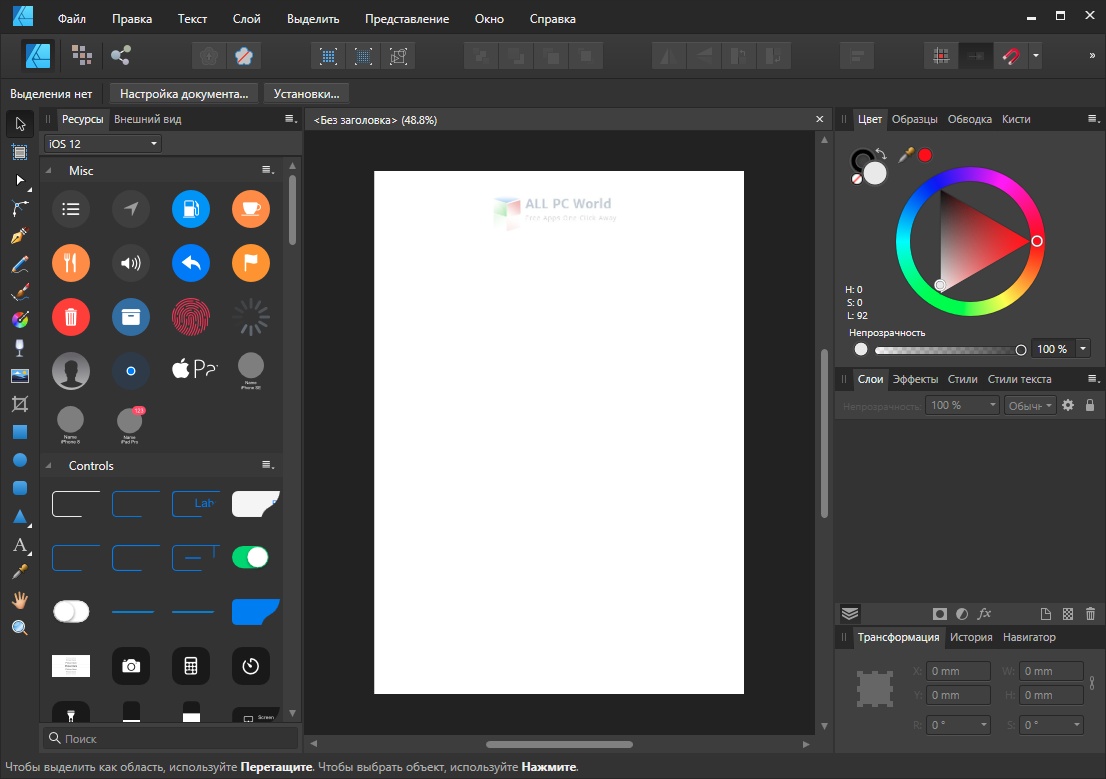
Like objects, artboards can be sized. For example, you’d typically create artboards at actual mobile device sizes or physical page sizes (compliment slips, letterheads, business cards, etc).
Artboards can also:
Affinity Designer Mobile Home
- Take a coloured stroke/fill, opacity, etc.
- Clip (contain) objects within the artboard (clip to canvas)
- Scale contents as the artboard is resized
Document settings
One key aspect of artboard usage is that the document settings established at document creation are shared across all artboards. These include:
- Colour space (RGB, CMYK, etc.)
- DPI
- Margins
- Bleed settings
- Measurement units (pixels, centimetres, inches, etc.)
Affinity Designer Mobile Al
You can’t change the above settings on a per artboard basis. As a result, at document setup:
- For professional printing: use 300dpi and CMYK colour space
- For web page mockups: use 72dpi and RGB colour space
- For mobile device mockups: use 144dpi and RGB colour space
Affinity and artboards
In the Affinity product range, artboards are unique to Affinity Designer (both Mac and Windows).
In Affinity Publisher, you can place a Designer document’s artboard in your document. The original Designer file, if linked and altered, will update in Publisher automatically.
If you haven’t tried artboards before, you can create one directly from Designer’s New Document dialog or at any time in session using the Artboard Tool. Why not watch the official Serif video for more information.
So, how were they made?
When you work with textures in your designs you can’t help but notice the gnarly old paint on the slide when you’re at the park with your kid. Collecting interesting and unusual real-world textures is where this started, many of which were taken from this same dilapidated playground, they were then edited to create a bold, inked look.
Originally the collection was created by Bob for use in his own projects, the Styles in this collection are a shorthand way to apply awesome texture and pattern to projects. Paired with vector brushes that add interest to line-art and texture to the edges of shapes, plus a set of ultra-useful assets, this collection grew and grew into the monster you see before you!
What do you get?

- 92 Assets
- 25 Vector Brushes
- 100 Styles (split into 3 parts)
- Part 1—44 Styles
- Part 2—36 Styles
- Part 3—20 Styles (100 in total)
How should I use them?
The Shizzle Style and Brush Pack is a toolkit for enhancing your vector art. The vector Brushes can be added to vector lines to add texture and pattern, the Styles add instant bitmap texture and grunge to your vector shapes and the Assets are a collection of useful resources that can be dropped onto your canvas at any time. Resize and fine-tune your creations through the wonder of Affinity Designer’s Appearance Studio.
The Shizzle Brushes
Draw a vector line and add a vector brushstroke for instant interest. It doesn’t have to be an outline either, use the brushes for scribbled textures and gradual grainy shading. The great thing about using vector brushes for shading is you can change the brushstroke, tweak the vector curve and recolour them til your heart’s content, no erasing or redrawing necessary. If you need to make quick changes to your client projects or like to change your mind a lot, this is the way to go!
The Shizzle Styles—in three parts
Grizzle up your vectors using the Shizzle Styles. In just one click, you can add grains, dots, shadows, hand-drawn patterns, tones and textures to your work to give it that extra oomph. Styles work by selecting a vector shape and clicking the Style of your choice in the Styles Panel to apply it to the shape. You can then edit using the Appearance Studio.
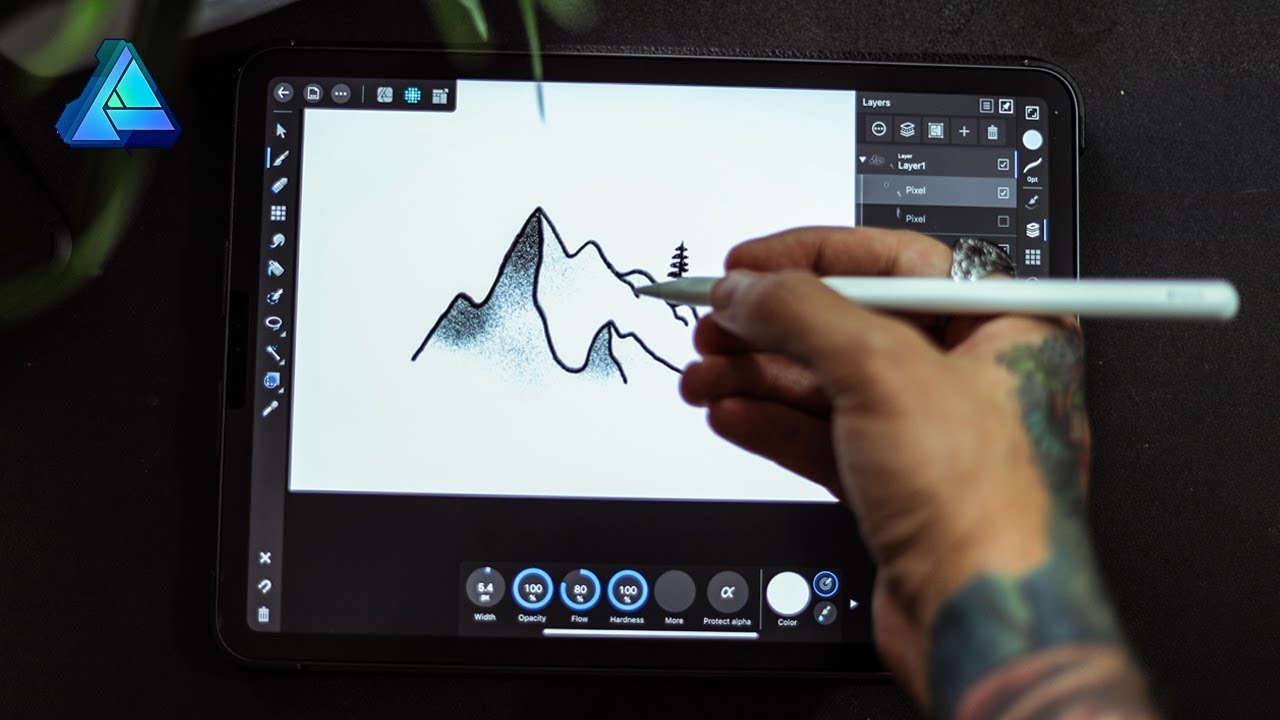
The Shizzle Assets
Drag and drop or insert an asset from the Assets Panel, colour it, clip it, use it as a mask, the options are endless. Shapes and patterns, great for building up comic book panels or for experimenting with the other elements of this collection.
Subcategories include Shiznuggets—bits and bobs to play around with, shadows, lines with brushes pre-applied and ready to edit, line groups that create patterns waiting for some magic and perfect for clipping, irregular circles and rough edges squares and much more.
Inspiration
Check out some of the cool illustrations Bob has created using the brushes, styles and assets in The Shizzle Style and Brush Pack.
Where can I get hold of this epic collection?
The Shizzle Style and Brush Pack is now available to purchase on the Affinity store.
About the creator
Bob Byrne is an Irish freelance illustrator and product designer. Since founding Clamnuts design studio 20 years ago with its roots in Irish underground comic and zine culture, Bob has expanded his company to encompass the Dr Moku language learning apps and product range, animations and illustration for top brands such as Cadbury and mobile game development, with more products and apps on the horizon. Bob has been involved in the development of Affinity products from the early days, with his feedback and experience helping shape the apps.
You can see more of Bob’s work on the Clamnuts website and Twitter.
You can also read our behind the scenes interview with Bob here and check out his Affinity Lockdown 2020 Creative Session on YouTube where he talks us through how to use Styles in animated projects.