
- Bonus Download: Grab my free Color Theory Cheat Sheet. One of the best ways of learning how light and color work is to paint the same subject in different environments. Claude Monet did this all throughout his career, most notably demonstrated through his many haystack paintings. Claude Monet did so many paintings of haystacks you would think he had some kind of obsession with them.
- Claude Monet was in almost every sense the founder of French Impressionist painting, the term itself coming from one of his paintings, Impression, Sunrise. As a child, his father wanted him to go into the grocery business, but his heart was in the profession of artistry, and at age 11, he entered Le Havre secondary school of the arts.
- The most widely known French Impressionist, Claude Monet moe-NAY was born in Paris and grew up on the Normandy coast. His father was a wholesale grocer, and after his mother died when he was 17, an aunt encouraged Monet in his efforts to become an artist.
- Value Arts Trinket Dish, Claude Monet Bridge Over a Pond of Water Lilies, Rectangular Glass Catchall Jewelry Tray, 5.75 Inches Wide. 4.3 out of 5 stars.
- Clarity Claude Monet Paintings
- Original Claude Monet Paintings
- Claude Monet Britannica
- Clarity Claude Monet Meaning

First name: Oscar-Claude
Last name: Monet
Frost, 1880 by Claude Monet as fine art print. High-quality museum quality from Austrian manufactory. Stretched on canvas or printed as photo. We produce your artwork exactly like you wish. With or without painting frame.
Born: 14 November 1840
Place of birth: Paris, France
Died: 5 December 1926 (aged 86)
Nationaltity: French
Famous Works: Impression Sunrise, Water Lilies, Japanese bridge
Claude Monet is a French painter known for his significant contribution to the Impressionist art movement. Born in Paris on November 14, 1840, he spent his childhood in the city of Havre (Normandy) where his family moved when he was five years old. Monet developed his passion over time, starting with caricature and then, encouraged by his father, painting, which he studied in Paris in 1859 at the Swiss Academy. Monet’s military service in Algeria in 1861 cut short his studies but he nonetheless continued to experiment with different artistic forms. Forced to return to Paris in 1862 following an illness he contracted (pleurisy), Monet met the Swiss painter Charles Gleyre and also worked with Alfred Sisley, Auguste Renoir and Frédéric Basille who all become his close friends.
During the second half of the 1860s, Monet painted in a style reminiscent of Edouard Manet. As he developed his own style, Monet faced some financial difficulties; despite the success of The Woman in a Green Dress (La Femme en robe verte) that immortalizes Camille Doncieux, whom he married in 1870, no art gallery would expose his work. Monet thus went to London at the same time the Franco-Prussian War broke out and there he met the art dealer Paul Durand-Ruel who would buy his works and help in making Monet’s impressionist paintings known.

A small part of the future impressionist group -- Monet, Manet and Renoir -- met up in 1872 in Argenteuil where the movement’s very first work, Impression, Rising Sun (Impression, soleil levant), was produced and which later gave its name to the movement. This painting was exhibited to the public during the first impressionist exhibition in 1874. This year would indeed mark the height of the impressionist movement and would define Monet as one of its creators. Despite criticism, the impressionists would produce six exhibitions until 1882. And Durant-Ruel’s continual purchases would allow Monet to live a decent life without having to participate in official art fairs.
Monet finally moved to Giverny with his partner Alice Hoschedé in 1883 along with her six children from a marriage to Ernest Hoschedé and with two children from Monet’s marriage (the youngest never knew his mother who died in labor in 1879). Giverny was a veritable haven for Monet. Despite numerous trips around France to gather inspiration, he bought the Giverny house and grounds in 1890; there the gardens would inspire him to create paintings that are today extremely famous such as the White Water Lily series (les Nymphéas). Monet died in his home at Giverny on December 5, 1926, surrounded by his family. Following his death, the Money Foundation was created to maintain the grounds and open it to the public.
The best way to discover the history of the artist and Monet's paintings is through one of the several Giverny tours that PARISCityVISION offers. We will show you around the top things to see in Giverny such as Monet's house and gardens and the Giverny Museum of Impressionisms.
Our editors will review what you’ve submitted and determine whether to revise the article.
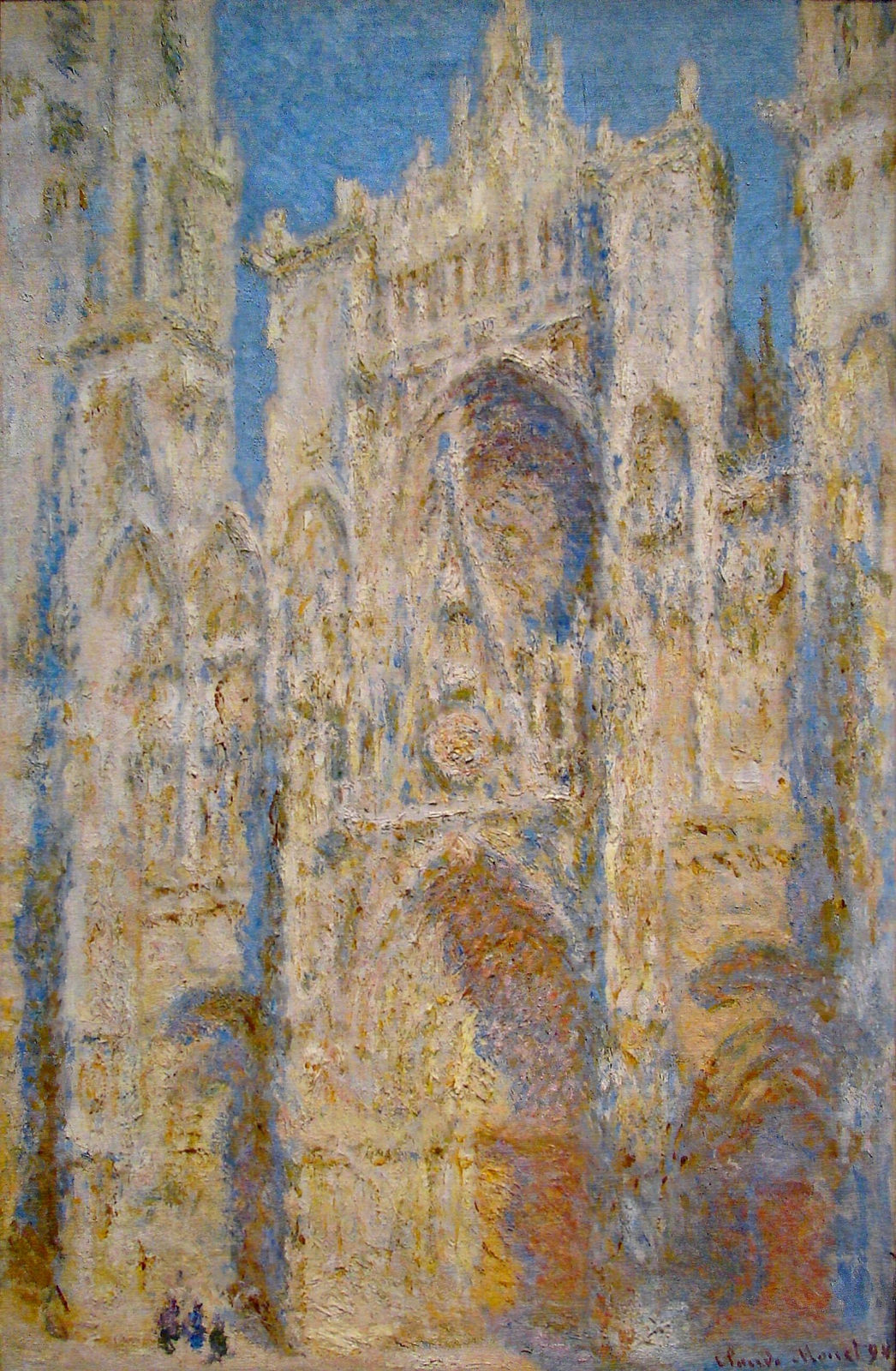
Join Britannica's Publishing Partner Program and our community of experts to gain a global audience for your work!Claude Monet, in full Oscar-Claude Monet, (born November 14, 1840, Paris, France—died December 5, 1926, Giverny), French painter who was the initiator, leader, and unswerving advocate of the Impressionist style. In his mature works, Monet developed his method of producing repeated studies of the same motif in series, changing canvases with the light or as his interest shifted. These series were frequently exhibited in groups—for example, his images of haystacks (1890/91) and the Rouen cathedral (1894). At his home in Giverny, Monet created the water-lily pond that served as inspiration for his last series of paintings. His popularity soared in the second half of the 20th century, when his works traveled the world in museum exhibitions that attracted record-breaking crowds and marketed popular commercial items featuring imagery from his art.
What was Claude Monet’s early life like?
When Claude Monet was five years old, he and his family moved to the Normandy coast, near Le Havre, France. His childhood was spent along the beaches, and the intimate knowledge he gained of the sea and the rapidly shifting Norman weather later influenced his art, which displayed his fresh vision of nature.
Where was Claude Monet educated?
Claude Monet did not receive a formal artistic education but learned informally from other artists. As a teenager, he studied drawing with a local artist. Later, Monet was befriended by Eugène Boudin, who introduced him to painting in the open air. To his family’s annoyance, Monet refused to enroll in the École des Beaux-Arts.
Clarity Claude Monet Paintings
Why is Claude Monet famous?
Claude Monet achieved fame for being the initiator, leader, and unswerving advocate of the Impressionist style. In his work he did not try to reproduce a scene faithfully as examined in detail but rather attempted to record on the spot the impression that a relaxed, momentary vision of the scene gave him.
How did Claude Monet influence others?
Claude Monet’s influence on other artists was wide-ranging, from his near contemporaries such as Vincent van Gogh to a diverse new generation of artists such as Pierre Bonnard and Henri Matisse. Visiting American artists adopted his fresh palette, subject matter, and spontaneous style and eventually introduced those elements to American art.
Childhood and early works
When Claude, the eldest son of Adolphe Monet, a grocer, was five years old, the family moved to the Normandy coast, near Le Havre, where his father took over the management of his family’s thriving ship-chandlering and grocery business. This event has more than biographical significance, for it was Monet’s childhood, spent along the beaches, and the intimate knowledge he gained of the sea and the rapidly shifting Norman weather, that would one day give rise to his fresh vision of nature. Monet’s first success as an artist came when he was 15, with the sale of caricatures that were carefully observed and well drawn. In these early years he also executed pencil sketches of sailing ships, which were almost technical in their clear descriptiveness. His aunt, Marie-Jeanne Lecadre, was an amateur painter, and, perhaps at her suggestion, Claude went to study drawing with a local artist. But his life as a painter did not begin until he was befriended by Eugène Boudin, who introduced the somewhat arrogant student to the practice—then uncommon—of painting in the open air. The experience set the direction for Monet, who for more than 60 years would concentrate on visible phenomena and on the innovation of effective methods to transform perception into pigment.
Although oil landscapes had been painted at least since the 16th century, they usually were produced in the studio—recollections, rather than direct impressions, of observations of nature. The English painters John Constable and J.M.W. Turner made small oil sketches out-of-doors before 1810, but it is unlikely that Monet knew these studies. He first visited Paris in 1859–60, where he was impressed by the work of the Barbizon-school painters Charles Daubigny and Constant Troyon. To his family’s annoyance, he refused to enroll in the École des Beaux-Arts. Instead, he frequented the haunts of advanced artists and worked at the Académie Suisse, where he met Camille Pissarro. This informal training was interrupted by a call to military service; he served from 1861 to 1862 in Algeria, where he was excited by the African light and colour. Monet’s choice of Algeria for service was perhaps a result of his admiration for the Romantic painter Eugène Delacroix, whose colouristic work had been influenced by a visit to Morocco in 1832.
In 1862 Monet returned to Le Havre, perhaps because of illness, and again painted the sea with Boudin, while also meeting the Dutch marine painter Johan Barthold Jongkind. Later that year he continued to study in Paris, this time with the academician Charles Gleyre, in whose atelier he met the artists Frédéric Bazille, Alfred Sisley, and Pierre-Auguste Renoir. After disagreements with their master, the group departed for the village of Chailly-en-Bière, near Barbizon in the forest of Fontainebleau. It was also during this period—or at least before 1872—that Monet discovered Japanese prints, the decorativeness and flatness of which were to have a strong influence on the development of modern painting in France.
The exceptional achievements of Monet’s prolific youthful period can be measured in works completed between 1865 and 1870, before he had begun to fragment his brushstrokes into the characteristic broken touches that were to become the hallmark of Impressionist style. One of the most ambitious of these early works (which was never finished, supposedly because of negative comments by Gustave Courbet) was Le Déjeuner sur l’herbe (1865–66; “Luncheon on the Grass”), named after Édouard Manet’s notorious painting shown in the Salon des Refusés in 1863. In contrast to Manet’s masterpiece, which was a shocking adaptation of a Renaissance visual idea to a contemporary setting, Monet’s painting was an utterly contemporary yet unprovocative representation of a group of fashionably dressed picnickers in the forest of Fontainebleau. Monet did share with Manet, however, a concern for representing actual scenes of modern life rather than contrived historical, romantic, or fanciful subjects. Thus, Monet’s Déjeuner was an extension, by virtue of a more immediate empiricism, of the Realism of Courbet.
Original Claude Monet Paintings
Impressionism, broadly viewed, was a celebration of the pleasures of middle-class life; indeed, Monet’s subject matter from this period often involved domestic scenes featuring his wife, son, and garden. Yet, painting la vie moderne (“modern life”) was not to be the primary aim of Monet’s art. Of more significance in his case was his ceaseless search for painterly means to implement his radical view of nature. More so than his ambitious figure paintings, such works as On the Bank of the Seine, Bennecourt (1868) or The Beach at Sainte-Adresse (1867) give a clear accounting of Monet’s advance toward the Impressionist style. In the beach and sea pictures of 1865–67 Monet was plainly not trying to reproduce faithfully the scene before him as examined in detail but rather attempting to record on the spot the impression that relaxed, momentary vision might receive—what is seen rather than what is known, with all its vitality and movement. Boats, buildings, incidental figures, and the pebble beach are swiftly brushed in as flat colour patterns, with little attention paid to their weight or solidity.
- born
- November 14, 1840
Paris, France
- died
- December 5, 1926 (aged 86)
Giverny, France
- notable works
- movement / style
Claude Monet Britannica
Clarity Claude Monet Meaning
- Monet hired gardeners to dust the surface of his pond before he painted it.